We watched a project on Great Northern Road stall for three weeks last March. The contractor had assumed stiff clay based on the borehole log, but the samples showed a liquid limit of 68% and a plasticity index above 35. That meant a highly plastic, low-bearing soil that the standard foundation design could not handle. In Aberdeen, the glacial tills and the alluvial deposits along the River Dee can vary from sandy silt to fat clay within 50 metres. The only way to pin down the behaviour is with a full set of Atterberg limits tests run under BS 1377-2. Our lab processes these daily for engineers across the Granite City who need reliable classification before they commit to a foundation type. We combine the Atterberg results with grain size analysis when the fines content exceeds 35%, giving a complete picture of the soil's engineering properties.
A plasticity index above 30 in Aberdeen's alluvial clays means you should expect significant shrinkage and swelling — design the foundation accordingly.
Our approach and scope
Site-specific factors
Aberdeen sits at an elevation of roughly 25 metres above sea level near the city centre, but the real geotechnical risk lies in the buried valleys carved into the bedrock during the last glaciation. These channels are filled with soft, normally consolidated clays that can reach 30 metres in thickness. The Atterberg limits on these deposits often reveal a liquidity index close to 1.0 — meaning the soil is near its liquid limit in situ. That is a sensitive condition. Any disturbance during excavation or piling can trigger a collapse of the soil structure and a sudden loss of strength. We have seen this in the Altens industrial area and along the North Deeside Road corridor. The classification data from our lab gives the design team the early warning they need. A high plasticity clay with a liquidity index above 0.8 demands a different construction approach — deeper piles, preloading, or ground improvement — compared to the stiff till found just a few hundred metres away.
Service video
Regulatory framework
BS 1377-2:1990 — Classification tests, BS 5930:2015+A1:2020 — Code of practice for ground investigations, Eurocode 7 (BS EN 1997-2:2007) — Ground investigation and testing
Complementary services
Grain Size Distribution
Wet sieving and sedimentation by hydrometer (BS 1377-2). Essential for determining the full particle size curve and confirming the fines classification from the Atterberg results.
One-Dimensional Consolidation
Oedometer testing to BS 1377-5 for settlement analysis on the soft clays found in Aberdeen's buried valleys. Provides mv and cv values for consolidation rate calculations.
Triaxial Compression
Undrained and drained triaxial tests on cohesive soils to determine shear strength parameters c' and φ'. Critical for slope stability and retaining wall design in the city's variable till deposits.
Typical parameters
Common questions
How much do Atterberg limits tests cost for a single sample in Aberdeen?
For a standard set of liquid limit and plastic limit tests on one sample, the cost ranges from £50 to £90 depending on the preparation required and the reporting format. We provide a fixed quote before starting any work.
What is the difference between the cone penetrometer and the Casagrande cup method for liquid limit?
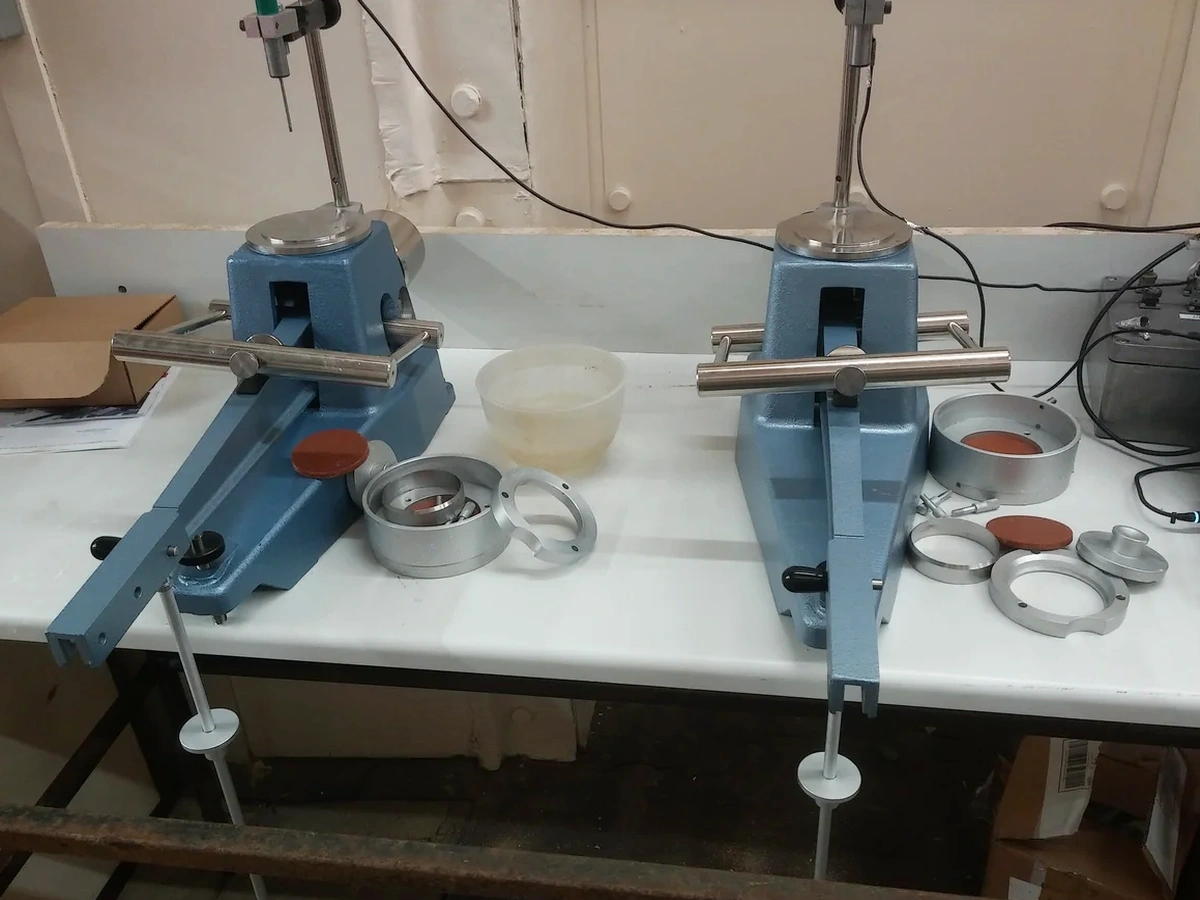
The cone penetrometer method (BS 1377-2, Clause 4.3) uses an 80 g, 30° cone and measures penetration at different water contents. It gives better repeatability with an operator variance typically under 1%. The Casagrande cup relies on counting blows to close a groove and is more operator-sensitive. We default to the cone method unless the specification demands the cup.
How long does it take to get the Atterberg limits results from your Aberdeen laboratory?
Standard turnaround is three working days from sample receipt. We can process urgent samples in 24 hours when the project schedule demands it. The drying and sieving stage takes the most time — we cannot accelerate that without compromising the result.