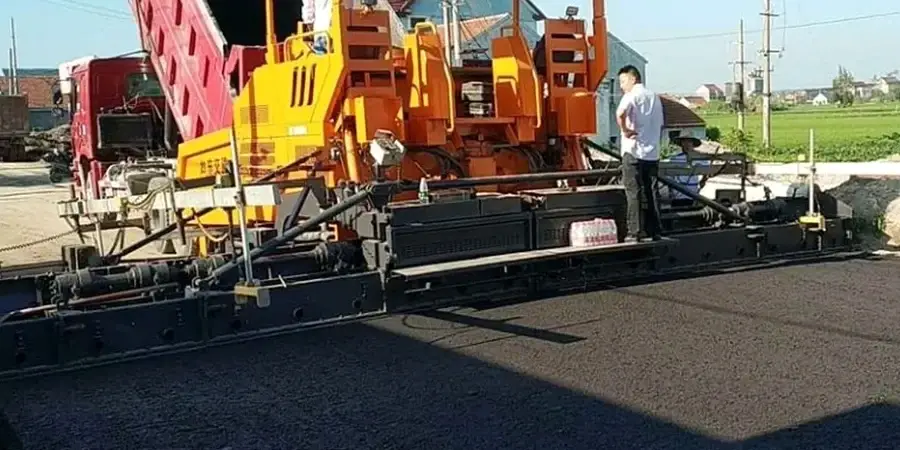
A common mistake in Aberdeen is treating pavement design as a standard catalogue exercise. The city sits on a mix of granitic till, boulder clay, and pockets of soft alluvium along the River Dee. Standard designs fail here. You get rutting. Cracking. Premature failure. Our flexible pavement design service models the actual subgrade stiffness. We test the in-situ material. We run traffic projections. The output is a layered asphalt structure that works with the ground, not against it. For projects near the harbour where saturated silts dominate, we often integrate findings from a site investigation with test pits to calibrate the CBR profile before finalising the pavement layers.
A pavement is only as strong as its weakest layer. In Aberdeen, that is usually the subgrade, not the asphalt.
Our approach and scope
Site-specific factors
Compare two sites: one in Westhill, another in Torry. Westhill sits on competent granitic till. The CBR might exceed 8%. A standard pavement design works there. Torry, near the harbour, rests on saturated silts and made ground. The CBR can drop below 2%. A standard design will rut within two winters. The risk is not theoretical. It is a direct cost to the developer. Failure means digging out the pavement, importing new material, and starting over. That can double your initial budget. Our design mitigates this risk by specifying a thicker capping layer, or by stabilising the subgrade with lime or cement where the moisture content is too high. We also model the frost penetration depth, which is critical given Aberdeen's exposed coastal climate and the recorded 80 frost days per year historically observed in the region.
Regulatory framework
DMRB CD 226: Design for New Pavement Construction, BS 5930:2015+A1:2020: Code of practice for ground investigations, BS EN 13108: Bituminous mixtures - Material specifications, Manual of Contract Documents for Highway Works (MCHW), Series 900
Complementary services
Full Flexible Pavement Design Report
A comprehensive package including subgrade assessment, traffic analysis, layer thickness optimisation, and material specification. We produce a design report suitable for planning submission and construction tender. The report addresses drainage design, frost protection, and long-term maintenance considerations for your project in Aberdeen.
Pavement Condition and Remediation Design
For existing pavements in Aberdeen showing distress, we conduct a forensic investigation. We core the asphalt, perform deflection testing with a falling weight deflectometer, and analyse the subgrade. We then design an overlay or full reconstruction strategy that extends the asset life without repeating the original design flaws.
Typical parameters
Common questions
What is the typical cost for a flexible pavement design project in Aberdeen?
For a standard commercial car park or access road in the Aberdeen area, a full flexible pavement design package typically ranges from £1,460 to £4,370. The final fee depends on the project size, traffic loading complexity, and the extent of the site investigation required to determine the subgrade properties.
How does the local granite subgrade affect the pavement design?
The granite-derived soils in Aberdeen can be excellent bearing materials, but they are often graded as frost-susceptible silty sands. This means the design must include a sufficiently thick sub-base layer to prevent frost heave, which is not always obvious from a simple CBR test. We account for this by applying the wet-freeze index specific to North East Scotland in our layer calculations.
Which traffic loading do you design for?
We design for commercial vehicle loading expressed in million standard axles (msa). For a typical distribution centre in Aberdeen, we would agree on a design traffic forecast with the client, usually between 5 and 20 msa for a 20-year design life. This determines the total asphalt thickness and the stiffness modulus required for each bound layer.