Underground excavations in Aberdeen represent a critical discipline within geotechnical engineering, encompassing the planning, design, construction and support of subterranean spaces across the city and wider Aberdeenshire. From utility tunnels and sewer upgrades to deep basements, road underpasses and energy infrastructure, this category addresses the full lifecycle of creating stable, safe cavities beneath the surface. The importance of underground excavation here is amplified by the city's dense urban fabric, historic granite architecture and the pressing need to upgrade ageing infrastructure without disrupting the vibrant life above. Properly executed, these projects unlock space in constrained environments, protect existing structures and enable the sustainable growth that Aberdeen's evolving economy demands.
The local geology is both a challenge and an asset. Aberdeen is famously underlain by the Aberdeen Granite Formation, a hard, crystalline rock that offers high strength but brings significant abrasiveness and joint-controlled instability. Overlying this bedrock are variable deposits of glacial till, sands, gravels and soft alluvial silts along the River Dee and River Don corridors. This means a single project can transition from hard rock tunnelling into water-bearing soft ground, demanding a flexible, multi-disciplinary approach. The presence of fractured granite aquifers also introduces groundwater management as a primary design consideration, requiring robust pre-construction ground investigation to map fracture networks, weathering profiles and potential inflow zones that could compromise excavation stability.
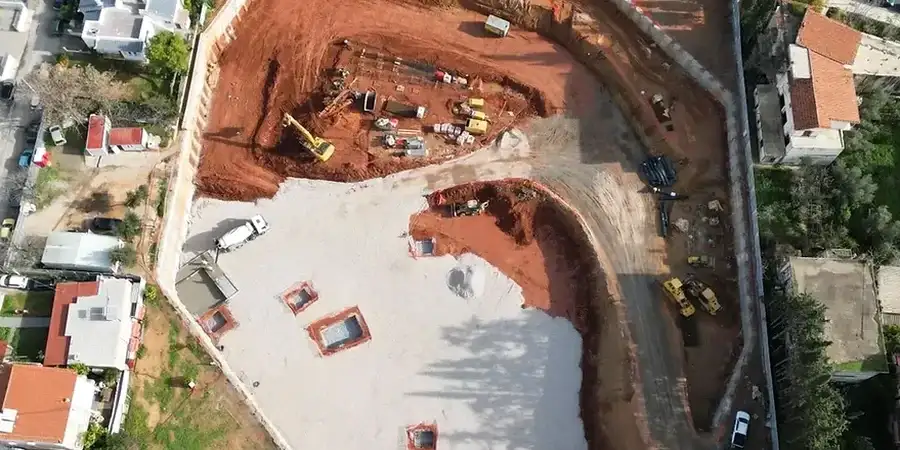
All underground excavation works in the UK must comply with the Construction (Design and Management) Regulations 2015 (CDM 2015), which place explicit duties on clients, designers and contractors to manage health and safety risks. For temporary works, BS 5975:2019 provides the code of practice for falsework and temporary support, while permanent design references Eurocode 7 (BS EN 1997-1 and -2) for geotechnical design, supplemented by the UK National Annexes. Crucially, any excavation that constitutes a confined space triggers the Confined Spaces Regulations 1997, and the Health and Safety at Work etc. Act 1974 remains the overarching legislation. For projects involving public roads or utilities, compliance with the New Roads and Street Works Act 1991 (NRSWA) and local authority permit schemes is mandatory, ensuring coordination and safety in Aberdeen's streets.
The range of projects requiring underground excavation expertise in Aberdeen is broad. Urban regeneration schemes frequently demand deep basements and integrated service tunnels, often requiring sophisticated geotechnical design of deep excavations to manage ground movements around listed granite buildings. Scottish Water's ongoing sewer network upgrades involve non-disruptive tunnelling beneath roads and residential areas, where geotechnical analysis for soft soil tunnels is essential to predict settlement and select appropriate tunnel boring machines or sequential excavation methods. Energy infrastructure, including cable tunnels for offshore wind connections, navigates mixed ground conditions that demand real-time geotechnical excavation monitoring to verify design assumptions and trigger contingency measures if deformation thresholds are approached. Even small-scale basement constructions in the West End require meticulous temporary works design to protect adjacent properties.
Common questions
What are the main geotechnical risks when excavating underground in Aberdeen's granite?
The primary risks stem from the rock mass's discontinuity pattern, including widely spaced but persistent joints that can form unstable wedges, especially where intersecting faults or weathered zones are present. High horizontal in-situ stresses locked into the granite can trigger spalling or strainbursts on exposed faces. Additionally, water ingress through open fractures can rapidly flood excavations, requiring systematic probe drilling and pre-grouting to manage hydrostatic pressures safely.
Which UK regulations govern temporary support design for deep excavations?
Temporary support design falls under CDM 2015 for overall safety management, with technical execution guided by BS 5975:2019 for falsework and temporary works procedures. The design must satisfy Eurocode 7 (BS EN 1997-1) for geotechnical limit states, using UK National Annex values. A Temporary Works Coordinator must be appointed, and all designs require independent checking. Where excavations are deep enough to become confined spaces, the Confined Spaces Regulations 1997 also apply.
How do soft ground conditions near Aberdeen's rivers affect tunnel excavation methods?
Soft alluvial silts, sands and gravels along the Dee and Don valleys typically exhibit low stand-up time and high groundwater permeability. This favours closed-face tunnelling methods like earth pressure balance (EPB) or slurry TBMs to maintain face stability and control settlement. Sequential excavation with spiling and grouting may be used for short crossings, but rigorous dewatering or ground treatment is essential to prevent running ground conditions and surface collapse.
What is the role of monitoring during underground excavation projects?
Monitoring provides continuous validation of design assumptions and early warning of adverse trends. It typically includes surface and subsurface settlement markers, inclinometers behind retaining walls, piezometers for groundwater pressure, and vibration sensors where blasting or mechanical excavation occurs near sensitive structures. Data is fed into an observational method framework, allowing the design to be adapted in near real-time if trigger values are exceeded, thereby preventing structural damage or safety incidents.