A contractor laying a new access road near the expanding Aberdeen Western Peripheral Route discovered the hard way that locally sourced glacial till from the area simply would not compact to specification. The material, a legacy of the Devensian glaciation that shaped Aberdeenshire, looked competent in the stockpile but failed density tests on the formation. The missing piece: a proper Proctor test to establish the relationship between moisture content and achievable dry density for that specific borrow source. Without the laboratory-derived compaction curve, even well-graded granite-derived soils common around the Rubislaw Quarry area can behave unpredictably once placed and rolled. Our team steps in at this precise stage, running both standard and modified Proctor compaction tests to BS 1377-4 on materials from sites across Aberdeen, from the clay-rich tills of Kingswells to the sandy gravels near the River Don. The output is a clear specification target for field density control, often paired with sand cone density testing during construction to verify that the achieved compaction meets the design intent.
A soil's maximum dry density is not a fixed property — it depends entirely on the compactive effort applied. Specifying the wrong Proctor variant can under-design or over-specify the project by 5-10%.
Our approach and scope
Site-specific factors
The most persistent error we encounter on Aberdeen sites is the assumption that a single Proctor value applies across an entire earthwork footprint. A contractor will take one sample from the topsoil strip, run a standard Proctor, and then use that MDD/OMC pair to control compaction on a fill that is 80% different material from deeper excavation. The result: density tests fail, the engineer rejects the lift, and the project loses days while the correct compaction curve is established in the laboratory. In silty glacial deposits typical of the Dee and Don valleys, over-compacting above optimum moisture can also induce pore pressure build-up and create a 'pumping' layer that never achieves stable density. For engineered fill beneath raft or mat foundations in Aberdeen's commercial developments, the difference between a properly run modified Proctor and an assumed value can mean the difference between a compliant subgrade and costly rework. We recommend one Proctor determination per distinct material type encountered, with the selection of standard versus modified effort matched to the compaction plant the contractor intends to use on site.
Regulatory framework
BS 1377-4:1990 (Methods of test for soils for civil engineering purposes — Compaction-related tests), BS EN 1997-2:2007 (Eurocode 7 — Ground investigation and testing), Manual of Contract Documents for Highway Works (MCHW) Series 600 — Earthworks, UKAS Accreditation to ISO/IEC 17025 for compaction testing
Complementary services
Standard Proctor (BS Light Compaction)
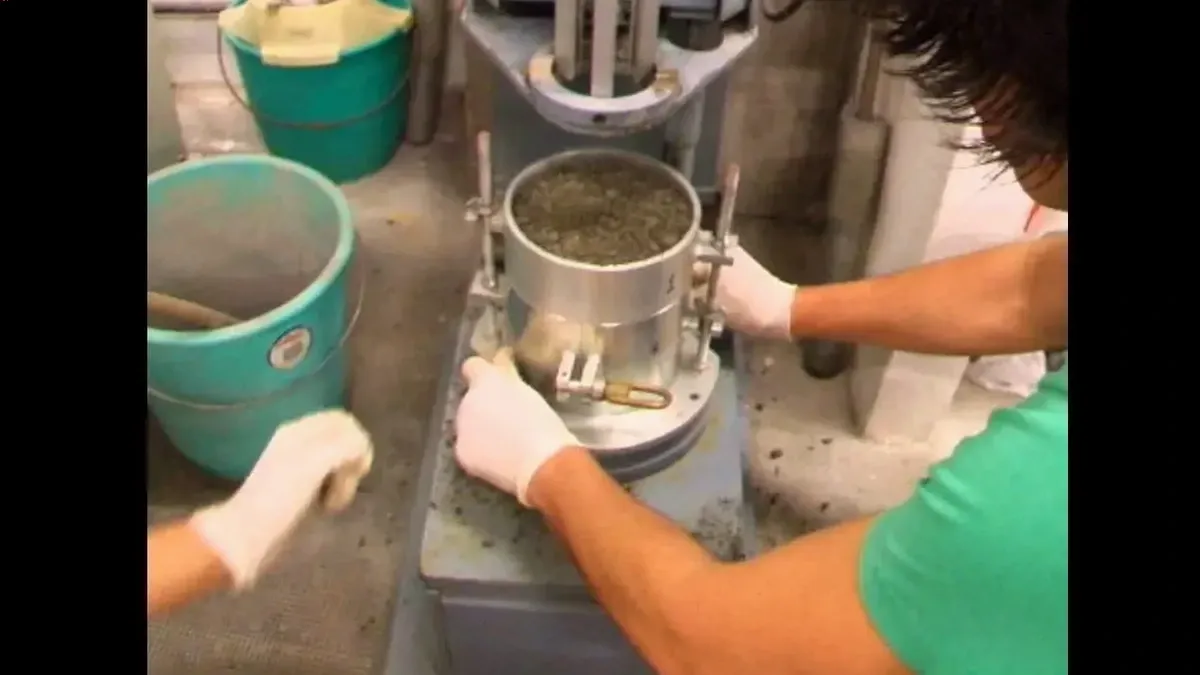
Using the 2.5 kg rammer and 1-litre mould, this test is suited to subgrade preparation, landscaping fill, and low-traffic pavement layers where compaction effort from site plant is moderate. Common for housing developments and cycle path construction in Aberdeen.
Modified Proctor (BS Heavy Compaction)
Employs the 4.5 kg rammer with higher energy input, reflecting the compaction achievable by heavy vibratory rollers. Specified for trunk road embankments, commercial building pads, and any engineered fill requiring high stiffness and low settlement.
Compaction Curve Suite (Multi-Point)
Full 5- or 6-point determination for each distinct material on a site, with oversize correction where gravel content exceeds the allowable threshold. Includes a technical interpretation memo relating results to the site earthworks specification.
Typical parameters
Common questions
How much does a Proctor test cost in Aberdeen?
A single standard or modified Proctor compaction test typically ranges from £80 to £160 per sample, depending on the number of points on the curve and whether an oversize correction is needed. For a full suite covering multiple material types on a typical Aberdeen development site, the laboratory fee is modest compared to the cost of density test failures and re-rolling during construction.
Which Proctor variant — standard or modified — should I specify for my Aberdeen project?
The choice depends on the compaction plant you intend to use and the end-use of the fill. For footpaths, landscaping, and lightly loaded residential slabs, standard Proctor (2.5 kg rammer) is generally appropriate. For road embankments, heavily loaded industrial slabs, and any fill beneath structural foundations in Aberdeen, modified Proctor (4.5 kg rammer) is the industry norm because it better represents the energy delivered by modern vibratory rollers. When in doubt, your project's earthworks specification should state the required compactive effort.
How much soil sample do I need to send for a Proctor test?
We require a minimum of 25 kg of representative material per Proctor determination, and ideally 40 kg if the soil contains significant gravel. The sample must be bagged in heavy-duty plastic sacks, sealed against moisture loss, and labelled with the location, depth, and material description. For multi-material sites in Aberdeen — where glacial till, sand, and weathered rock may all be encountered — separate samples of each distinct material type are essential for reliable results.
Can a Proctor test be performed on granular material with large particles?
BS 1377-4 allows Proctor testing on material with particles up to 37.5 mm. If larger gravel or cobbles are present, they are removed, weighed, and an oversize correction is applied to the reported maximum dry density. The correction method follows the procedure in BS 1377-4:1990. For very coarse, free-draining granular fills such as those from granite quarries near Aberdeen, the Proctor test may be supplemented with a relative density assessment to provide a more meaningful compaction target.