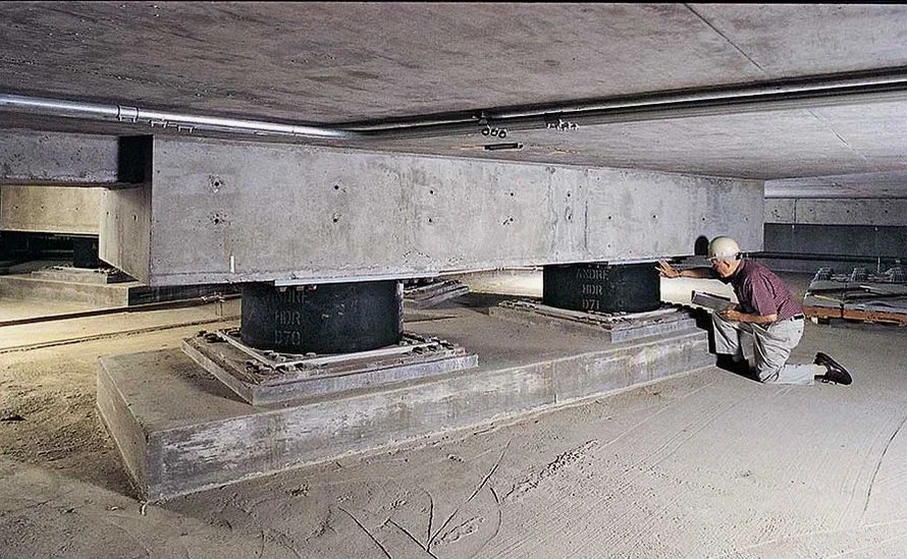
A recent mixed-use development on Union Street faced a peculiar challenge: the structural engineer needed to meet BS EN 1998-1 dynamic requirements, but the site sat directly on a transition zone between dense glacial till and weathered granite. The solution involved a tailored base isolation system that decoupled the six-storey frame from ground motion, accounting for Aberdeen's shallow bedrock profile. This is not California or Tokyo, but the UK's induced seismicity and the city's legacy mining voids under Footdee and Rosemount demand a proactive approach. When designing in Aberdeen, you are engineering for a city where the ground beneath your feet has a long memory. To characterise the subsoil stiffness properly, we often pair the isolation design with a MASW survey that maps shear wave velocity across the site, giving us the Vs30 value needed for site classification under Eurocode 8.
Effective base isolation in Aberdeen hinges on matching the isolator's horizontal stiffness to the site-specific ground period, not just the structural period.
Our approach and scope
Site-specific factors
The physical heart of the analysis sits in a high-performance computing cluster running time-history analyses with ground motions matched to the UK-specific uniform hazard spectrum. For an Aberdeen project, the team models the lead rubber bearings using a bilinear hysteretic loop, iterating the post-yield stiffness ratio until the superstructure's drift stays under 0.5% at the design basis earthquake. A common oversight on granite sites is underestimating vertical ground motion components, which can lift a sliding isolation system if the friction coefficient is set too low. The laboratory testing programme follows EN 15129, with prototype isolators subjected to three full cycles at maximum displacement plus ageing and scragging tests. When the analysis flags excessive residual displacement after a 2,500-year return period event, the design incorporates a moat wall with sacrificial dampers, a detail we specified for a data centre near Aberdeen Harbour where operational continuity was non-negotiable.
Regulatory framework
BS EN 1998-1:2004 + UK National Annex (Eurocode 8 – Seismic design), BS EN 15129:2018 (Anti-seismic devices – isolation bearings), BS EN 1997-1:2004 + UK NA (Eurocode 7 – Geotechnical design), ISO 22762 (Elastomeric seismic-protection isolators), BS 5930:2015 (Code of practice for ground investigations)
Complementary services
Seismic Hazard Assessment & Isolator Specification
We develop site-specific response spectra for Aberdeen coordinates and select the isolation system type, number, and layout. Deliverables include the design basis report, 3D model of the isolation plane, and technical specification for procurement under EN 15129.
Nonlinear Time-History Analysis & Peer Review
Full 3D structural model with isolator elements subjected to spectrum-compatible accelerograms. We verify superstructure performance, isolation gap adequacy, and service connections flexibility, producing a third-party review package for building control approval.
Typical parameters
Common questions
Is seismic base isolation really necessary for buildings in Aberdeen, given the low seismicity?
The UK National Annex to Eurocode 8 does not mandate base isolation for standard buildings in Aberdeen, but it becomes a cost-effective solution for essential facilities – hospitals, data centres, emergency response hubs – where post-earthquake functionality is critical. The investment protects against rare but plausible events (2,500-year return period) and can reduce insurance premiums for high-value assets.
What is the typical cost range for a base isolation design package for a medium-sized building in Aberdeen?
For a typical four- to eight-storey structure in the Aberdeen area, the full design package – including site-specific seismic hazard assessment, isolator specification, nonlinear analysis, and construction drawings – ranges from £2,840 to £6,980. The final figure depends on the number of isolators, complexity of the superstructure, and whether prototype testing is required under EN 15129.
How do you account for the granite bedrock in the isolation design?
Granite bedrock at shallow depth in Aberdeen means higher site stiffness and potentially higher short-period spectral accelerations. The design uses site-specific Vs30 measurements from MASW surveys to classify the ground correctly under Eurocode 8. The stiff bearing also allows a simplified interface detail beneath the isolators, avoiding the need for piled foundations in many cases.
What maintenance do base isolators require after installation?
Elastomeric isolators are generally maintenance-free, but the design must allow for periodic inspection as specified in EN 15129. The moat area around the isolation plane needs to remain free of debris, and any sacrificial fuses or dampers should be visually checked every five years. We provide a maintenance manual tailored to the specific isolator type and building use.