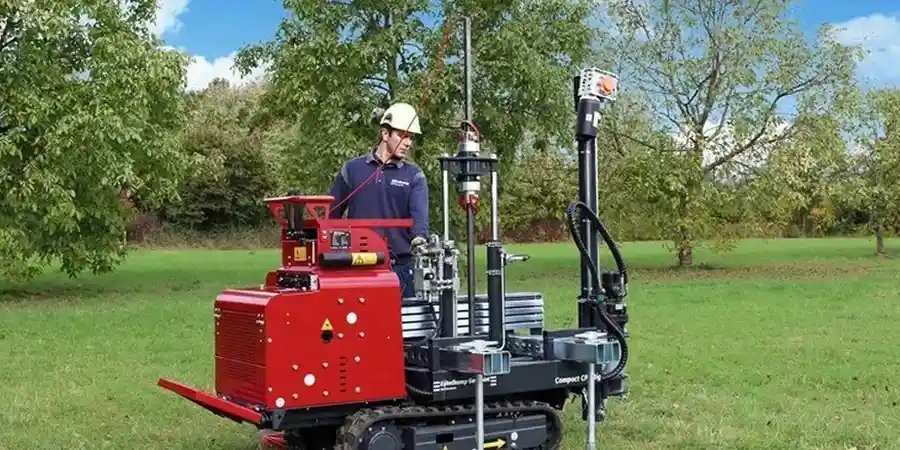
Aberdeen’s subsurface doesn’t read textbooks. You drill three metres and hit a granite boulder, then two metres over you’re in soft silty till. That’s why we run the CPT rig more days than not — it cuts through the guesswork. The CPT test gives us a continuous resistance profile without pulling samples, so we can map lenses and transitions that a borehole log misses. When a site on the north side of the Dee shows soft clays at depth, we often pair the cone with SPT drilling to calibrate the friction ratio against a physical sample. It’s a workflow born from working the grey granite city.
A CPT log in Aberdeen is a story of ice — till, lenses, and bedrock — read at 2 cm resolution.
Our approach and scope
Site-specific factors
A site in Cults and a site in Torry can sit on the same geological map unit and behave completely differently. Cults, up on the valley slope, often has a metre of weathered granite right below the topsoil — refusal depth is shallow and bearing capacity is rarely an issue. Torry, closer to the harbour, gets marine-influenced silts interbedded with the till. Push the cone there and the friction ratio drops through the silty bands, flagging a potential drainage problem for any shallow foundation. The risk isn’t the till — it’s the surprises inside it. A single CPT log from one corner of the plot is not enough. We run a grid of three to five soundings so the engineer can interpolate the contact surfaces with confidence, not guesswork. On sites near the Don, where buried channels filled with soft alluvium cut through the till, missing a low-strength pocket means a future differential settlement headache for the structural engineer.
Regulatory framework
BS EN ISO 22476-1:2012, Eurocode 7 (BS EN 1997-2:2007), BS 5930:2015+A1:2020
Complementary services
Piezocone CPTu Logging
Continuous digital profiling with qc, fs, and u2. We post-process the data to estimate soil behaviour type, undrained shear strength, and OCR for cohesive layers.
Dissipation Testing
Pore pressure decay recorded at selected depths to estimate coefficient of consolidation in clay lenses. Useful where the till contains soft pockets near the water table.
Combined CPT-SPT Investigation
CPT soundings correlated with rotary-drilled SPT boreholes at the same site. We use the paired data to calibrate the friction ratio and refine the ground model for piled foundations.
Typical parameters
Common questions
What does a CPT test cost for an Aberdeen residential plot?
For a single dwelling site in Aberdeen, a CPT investigation with two to three soundings to 8-15 metres depth typically runs between £120 and £180 per sounding, depending on the rig mobilisation and the depth achieved before refusal on granite. That covers the field work, digital log, and a factual report with interpreted soil behaviour type.
How deep can the CPT rig push in Aberdeen's glacial till?
In the stiff Aberdeen Formation till, our 200 kN rig reaches 15 to 25 metres routinely. The limiting factor is usually a granite boulder or the bedrock surface, not the till strength. When the cone hits a boulder, we note the refusal depth and offset the next sounding to check whether it was an isolated block or the actual rockhead.
Do we still need boreholes if we run CPT?
CPT gives you a continuous strength profile but no physical sample. Most projects in Aberdeen combine CPT with at least one cored or SPT borehole to confirm lithology and to run lab tests — shear box on the till, point load on granite fragments. The cone data then lets you interpolate between boreholes with far more confidence than drilling alone.