Aberdeen sits squarely on the Dalradian Supergroup. Much of the city centre and western expansion areas overlie layers of granitic till and glacial sands that can be frustratingly loose. The River Dee and River Don catchments add alluvial pockets where granular soils have never seen serious overburden pressure. When a site investigation returns SPT N-values below 10 in these materials, standard footings become a gamble. Vibrocompaction design offers a direct path to densify the ground before construction. We develop site-specific treatment grids using depth, grain-size distribution from grain-size analysis, and target relative density. The method works well in the free-draining sands found at Kingswells and Countesswells. It avoids the cost and carbon footprint of deep excavation and replacement. Our team applies BS EN 1997-1:2004 principles to verify that post-treatment parameters meet project bearing capacity and settlement criteria.
A well-designed vibrocompaction grid can take a site from N-value 6 to N-value 25 in a single pass—turning problematic fill into buildable ground without importing a single lorry of stone.
Our approach and scope
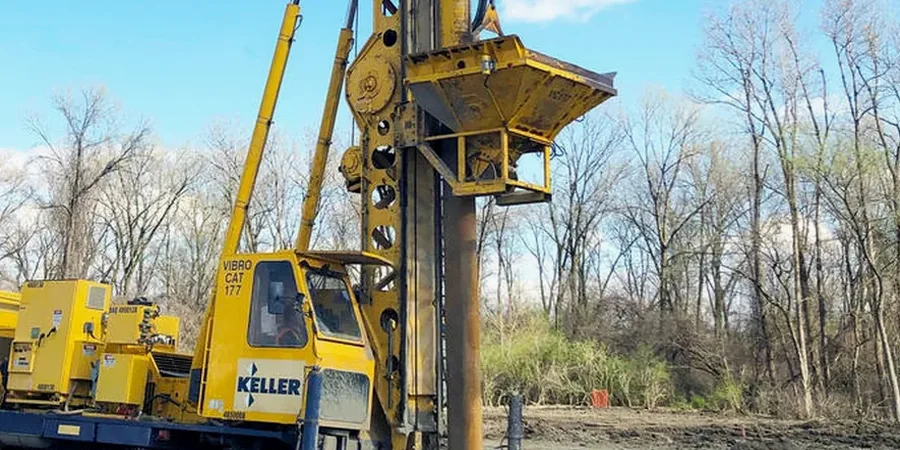
Site-specific factors
Ground conditions change abruptly across Aberdeen. The well-drained sandy gravels around Hazlehead behave very differently from the softer alluvial silts found near the old paper mills on the Don. Ignoring this contrast leads to differential settlement. A vibrocompaction design calibrated for the western suburbs will underperform in the river terraces. The method relies on granular drainage during vibration. Excess fines trap pore pressure and limit densification. If the soil has more than 15 percent passing the 63-micron sieve, the designer must either adjust expectations or switch technology. Misjudging this boundary is the most common failure mode we see. Our process includes a fines-content screening step early in the design phase. We also run sensitivity checks on groundwater fluctuation. In winter, Aberdeen's water table rises enough to alter the vibrator's effective radius by 10 to 15 percent.
Service video
Regulatory framework
BS EN 1997-1:2004 Eurocode 7 – Geotechnical design, BS 5930:2015+A1:2020 Code of practice for ground investigations, BS EN 1997-2:2007 Eurocode 7 – Ground investigation and testing
Complementary services
Grid Design & Spacing Analysis
Triangular or square grid layout optimised from grain-size curves, CPT tip resistance, and target relative density per BS EN 1997.
Test Section Specification
We design a trial zone with defined pass counts, hold times, and amperage targets. Post-treatment CPT verification confirms parameters before full production.
Fines Content Screening
Laboratory assessment of wash-sieved samples. If fines exceed the threshold, we adjust the technique or recommend stone columns as a fallback.
Settlement Verification
Comparative analysis of pre- and post-treatment modulus using CPT, SPT, or pressuremeter data to confirm serviceability limit state compliance.
Typical parameters
Common questions
What does vibrocompaction design cost for a typical Aberdeen site?
Most residential and light commercial projects in Aberdeen fall between £1,150 and £4,060 for the design package. The final figure depends on the number of treatment zones, depth of loose material, and the extent of post-treatment verification required.
How deep can vibrocompaction treat in Aberdeen's glacial sands?
Standard electric vibrators reach 15 to 20 metres. Deep hydraulic rigs can push to 30 metres. In Aberdeen, most loose sand lenses sit within the upper 12 metres, so a mid-range rig handles the majority of sites. We specify the equipment based on the borehole logs.
Can you use vibrocompaction if the soil has some silt in it?
It depends on the percentage. Below 10 to 12 percent fines, vibrocompaction performs well. Between 12 and 15 percent, we run a trial to confirm. Above 15 percent, the silt chokes drainage and we typically shift the design toward stone columns or dynamic replacement.
How do you verify the ground has been properly compacted?
We specify post-treatment CPT soundings on the same grid. Cone tip resistance must show a clear increase over the pre-treatment baseline. We also run SPT or pressuremeter tests where CPT access is tight. The acceptance criteria are written into the design before site work begins.