The granite city poses a unique set of challenges when you dig below the surface. We have seen projects across Aberdeen, from the West End to Altens, stall because the ground model assumed a uniform behavior that simply was not there. The truth is, between the alluvial pockets near the River Dee and the residual soils over the underlying granitic bedrock, shear strength can vary dramatically even within a single site. A standard triaxial test cuts through that uncertainty, providing a reliable picture of how the soil will actually behave under load. This is not just a box-ticking exercise for the building warrant; it is the foundation of a cost-effective foundation design. When we run a triaxial test on undisturbed samples, we are giving the structural engineer the numbers needed to avoid both over-design and, critically, under-design in this complex glacial terrain.
Effective stress parameters from a CU triaxial test are the single most valuable data point for a foundation engineer working in Aberdeen's glacial tills.
Our approach and scope
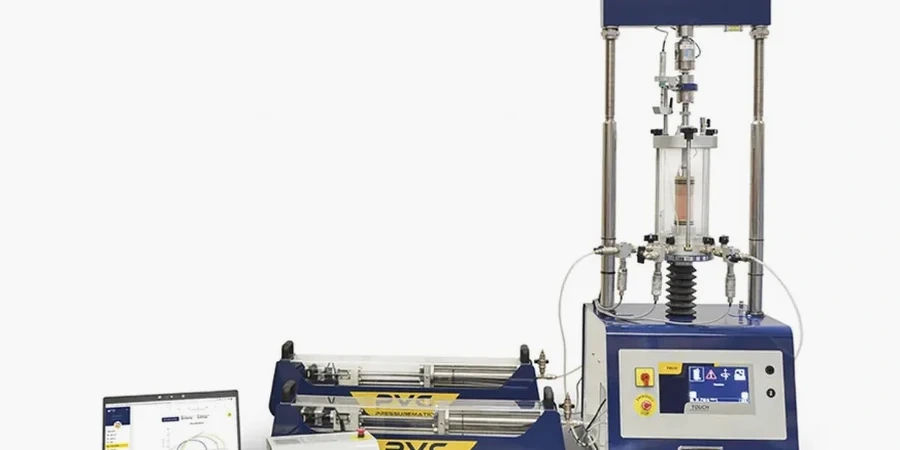
Site-specific factors
BS EN 1997-2:2007 (Eurocode 7 Part 2) leaves no room for guesswork when it comes to ground investigation for Geotechnical Category 2 structures. In Aberdeen, the risk of mischaracterizing a glacial till as a granular soil instead of a cohesive one can lead to a disastrous underestimation of pore water pressure buildup during loading. We have reviewed old site investigation reports where a generic friction angle was assumed, only for subsequent construction to reveal a much weaker, contractive soil layer. The slope-stability of an excavation or the bearing capacity of a footings system hinges directly on the shear strength parameters derived from a properly executed triaxial test. Ignoring the need for high-quality undisturbed sampling and testing in these complex Quaternary deposits is not a cost-saving measure; it is an open invitation for costly delays and remedial works when the ground does not perform as expected.
Regulatory framework
BS 1377-8:1990 - Methods of test for soils for civil engineering purposes. Shear strength tests (effective stress), BS EN ISO 17892-8:2018 - Geotechnical investigation and testing. Laboratory testing of soil. Unconsolidated undrained triaxial test, BS EN 1997-2:2007 (Eurocode 7 Part 2) - Ground investigation and testing
Complementary services
Advanced Triaxial Testing Suite (CU & CD)
A comprehensive program for critical infrastructure and commercial projects in Aberdeen. We perform multi-stage consolidated undrained tests to derive a single set of effective stress parameters (c' and phi') from one specimen, which is particularly useful for the stiff, overconsolidated tills found across the city. For deep basements in the city center, our drained tests provide the operational stiffness values needed for accurate soil-structure interaction models.
Standard UU Triaxial & Soil Classification
A rapid and cost-effective solution for preliminary site assessments and low-rise residential developments. The Unconsolidated Undrained test gives a reliable undrained shear strength (Cu) for cohesive layers. We report this alongside the results from our grain-size analysis to give you a full picture of the material's classification, making it a practical choice for initial feasibility studies on sites from Cults to Cove Bay.
Typical parameters
Common questions
What is the typical turnaround time for a triaxial test in Aberdeen?
For a standard CU or UU triaxial test, we typically report within 7 to 10 working days from the moment the undisturbed sample is received in our laboratory. Consolidated Drained (CD) tests take longer, usually 2 to 3 weeks, because of the slow shearing rate required to allow full pore pressure dissipation in fine-grained soils. If your project is on a tight schedule, mention it during the initial consultation and we can often expedite the process for an additional fee.
How much does a triaxial test cost for a project in Aberdeen?
The investment for a triaxial test program in Aberdeen is generally between £1,540 and £2,300 per test, depending on the type of test. A single UU test starts at the lower end of that range, while a CU test with pore pressure measurement or a multi-stage test sits at the upper end. The final cost depends on the number of specimens and the specific testing standard required by your design team.
Do you handle the sampling on site, or do we need to deliver the samples to you?
We can manage the entire process for you. Our team works with local drilling crews across Aberdeen who are experienced in taking high-quality Class 1 undisturbed samples from glacial tills using thin-walled Shelby tubes. We coordinate the sampling, transport the specimens to our lab in controlled conditions, and handle the extrusion and preparation. This end-to-end service eliminates the risk of sample disturbance from poor handling and ensures the chain of custody is maintained.
What is the difference between a UU and a CU test, and which one do I need?
An Unconsolidated Undrained (UU) test provides the total stress undrained shear strength (Cu). It is a quick test and suitable for short-term analysis on fully saturated clays, such as checking the stability of an excavation in Aberdeen's tills before drainage can occur. A Consolidated Undrained (CU) test gives effective stress parameters (c' and phi'). This is the test you need for long-term slope stability analysis, retaining wall design, or any situation where the ground will have time to drain and consolidate over the life of the structure.