The stability of natural and engineered slopes is a critical consideration for any construction or land development project in Aberdeen and the wider Aberdeenshire region. This category encompasses the full spectrum of geotechnical services required to assess, design, and implement solutions for slopes at risk of failure, from initial slope stability analysis through to the detailed design of retention systems. Given the city's unique topography, carved by the Rivers Dee and Don, and its relentless expansion into historically undeveloped hillsides, managing slope risks is not merely a regulatory requirement but a fundamental necessity for public safety and asset protection.
Aberdeen's geological context presents a distinctive set of challenges that directly influence slope behaviour. The underlying bedrock is predominantly the pinkish-grey Aberdeen Granite, a durable but heavily jointed and weathered material, particularly near the surface. Overlying this are variable superficial deposits of glacial till, a stiff, sandy, gravelly clay laid down during the last ice age, which can be susceptible to softening and erosion when wet. The combination of permeable, weathered granite and less permeable till creates conditions ripe for perched water tables and rapid pore water pressure increases during the city's frequent and intense rainfall events, making water management a central theme in any local slope design.
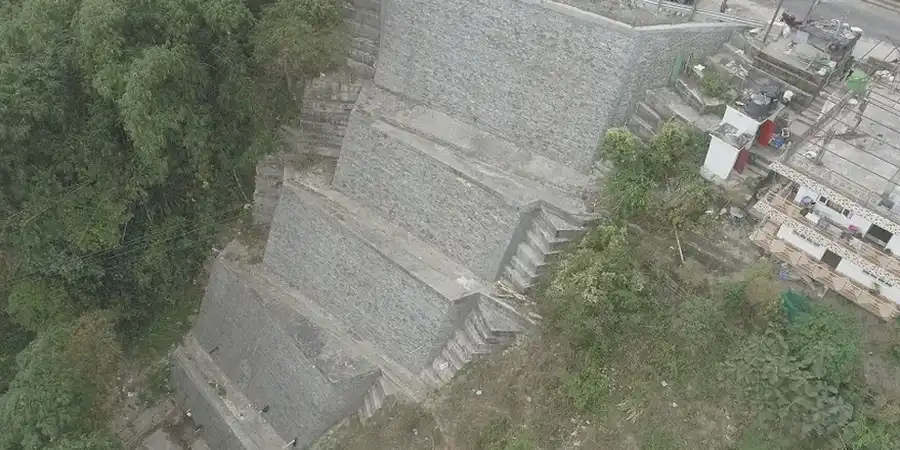
All slope-related works in the UK must adhere to the stringent framework of Eurocode 7 (BS EN 1997-1 and -2), specifically its UK National Annex, which governs geotechnical design. This is underpinned by BS 5930, the code of practice for ground investigations, and BS 8006 for strengthened and reinforced soils. For projects involving retaining structures, the design must rigorously follow BS EN 1992 (Eurocode 2) for concrete and BS EN 1993 (Eurocode 3) for steel elements. The Construction (Design and Management) Regulations 2015 (CDM 2015) also place a sharp focus on eliminating risks during both construction and long-term maintenance, a principle that is paramount when designing structures intended to hold back thousands of tonnes of earth for decades.
The requirement for these specialist services spans a wide array of project types across the Granite City. Residential developments on the city's steeper western fringes, such as those near Kingswells and Cults, routinely demand robust retaining wall design to create level building platforms. Infrastructure projects, including the Aberdeen Western Peripheral Route (AWPR), involved massive cuttings and embankments requiring sophisticated stabilisation measures. Coastal slope protection is vital along the North Sea shoreline, while even smaller-scale domestic extensions on a sloping garden in areas like Ferryhill can trigger the need for a formal stability assessment and the design of active/passive anchor design solutions to secure the land safely.
Common questions
What are the typical signs of slope instability I should look for on my property in Aberdeen?
Common indicators include fresh cracks in the ground or paving, tilting fence posts or retaining walls, the sudden appearance of water seepage where it was previously dry, and bulging at the base of a slope. On a larger scale, look for irregular, hummocky ground or trees with curved trunks ('pistol-butted'), which signal historical, slow-moving soil creep, a prevalent issue on Aberdeen's steeper, till-covered hillsides.
How do Aberdeen's granite and glacial till geology specifically affect slope design?
The weathered granite can be free-draining but contains corestones within a weaker matrix, creating unpredictable excavation conditions. The overlying glacial till is often strong when dry but loses significant strength when saturated. This contrast necessitates drainage designs that prevent water from ponding at the till's surface and saturating it, a primary trigger for shallow landslides in the region.
What is the difference between an active and a passive anchor for slope stabilisation?
An active anchor is tensioned against the soil or rock face during installation, immediately applying a stabilising force and minimising movement. A passive anchor, such as a soil nail, is not tensioned; it only develops its resisting force if the ground begins to move and deform, working through friction and passive resistance along its length to reinforce the soil mass.
What are the key UK regulations and standards governing the design of a retaining wall in Aberdeen?
The design must comply with Eurocode 7 (BS EN 1997) for geotechnical design, using Design Approach 1 for the UK. Structural design follows Eurocodes 2 and 3 for concrete and steel. The entire process, from ground investigation to construction, must adhere to BS 5930 and CDM 2015 regulations, with specific durability considerations for Aberdeen's coastal exposure and frequent freeze-thaw cycles.