Granite-derived soils across Aberdeen behave differently from textbook examples. We see it on sites every week — glacial till over weathered bedrock, groundwater perched in unexpected layers, and refusal depths that shift dramatically within a single plot. That is why a standard penetration test here demands more than routine procedure. The SPT, carried out to BS 5930:2015, gives us direct N-values that correlate with bearing capacity and settlement parameters for the mixed drift geology typical of the Dee and Don valleys. When foundation decisions carry cost implications for piling versus pad footings, having reliable blow count data from the exact depth of interest changes the entire structural approach. We often pair the SPT drilling programme with targeted lab testing on disturbed samples recovered from the split spoon to confirm fines content and plasticity for liquefaction screening.
A single SPT refusal at shallow depth in Aberdeen does not mean rock — it often means a granite boulder, and the difference costs thousands in unnecessary piling.
Our approach and scope
Site-specific factors
Aberdeen sits on the boundary between metamorphic basement and Devonian sedimentary rocks, and the overburden is anything but uniform. Glacial tills with erratic boulders, pockets of soft alluvium along the Don, and made ground from centuries of quarrying and harbour expansion create a patchwork where SPT refusal depths can vary by several metres over short distances. The biggest risk is under-investigation: running too few penetration tests and missing a soft zone that later causes differential settlement. Coastal groundwater adds another layer — chloride levels in the saturated till accelerate steel corrosion, so foundation depth decisions based on N-values must also account for durability. BS EN 1997-2 requires a minimum of three investigation points for most structures, but in Aberdeen's glacial terrain we rarely recommend fewer than five. The extra boreholes cost a fraction of what a foundation remediation would.
Regulatory framework
BS 5930:2015 + A1:2020 — Code of practice for ground investigations, BS EN 1997-2:2007 — Eurocode 7: Ground investigation and testing, BS EN ISO 22476-3:2005 — Dynamic probing and standard penetration test
Complementary services
Standard Penetration Test with Rotary Drilling
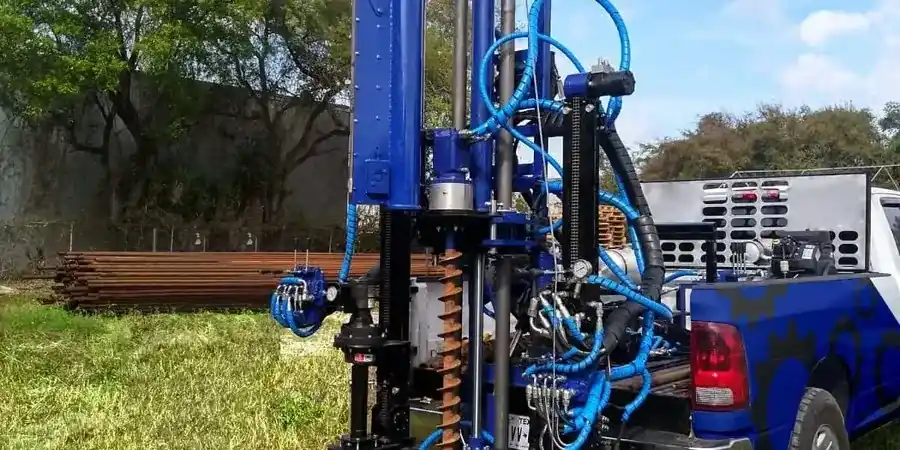
Full SPT programme using rotary or cable percussion rigs, logged to BS 5930 by chartered geotechnical engineers. Includes energy-calibrated automatic hammer, split spoon recovery, groundwater monitoring, and factual report with N-value versus depth plots for every borehole. Typical depth range 6-25 metres across Aberdeen city and shire.
SPT with Laboratory Classification Suite
Combined field penetration testing plus UKAS-accredited lab work on all recovered disturbed samples. Includes moisture content, Atterberg limits, particle size distribution by wet sieving, and sulphate/pH testing for buried concrete assessment to BRE SD1. Results delivered in a single interpretative report within five working days of rig demobilisation.
Typical parameters
Common questions
How much does an SPT investigation cost for a typical Aberdeen house plot?
For a single dwelling site in the Aberdeen area, an SPT investigation with three boreholes to depths of 6-10 metres typically falls between £480 and £630 per borehole, including the factual report and basic classification testing on recovered samples. The total depends on access conditions, depth to bedrock, and whether cable percussion or rotary drilling is required. Granite boulder obstructions can extend rig time, so we always allow a contingency day in the programme.
How does BS 5930 SPT testing differ from Eurocode 7 requirements?
BS 5930:2015 is the detailed execution standard — it specifies hammer type, sampler dimensions, seating drives, and how N-values are recorded and corrected. BS EN 1997-2 is the Eurocode framework that tells you how many boreholes are needed and how to derive characteristic geotechnical parameters from the SPT data. In practice, we work to both: BS 5930 governs the fieldwork, and Eurocode 7 governs the design parameter derivation. The two are complementary, not alternatives.
How many boreholes do we need for a commercial building in Aberdeen?
BS EN 1997-2 recommends a minimum of three investigation points for any structure, but for commercial buildings on Aberdeen's glacial till we typically specify five to seven boreholes with SPT at 1.5-metre intervals. The high lateral variability in till composition and bedrock depth means that three points often miss critical transitions. For structures over three storeys or with column loads above 500 kN, the extra investigation cost represents less than half a percent of the foundation budget.
What depth do you test to in Aberdeen's granite soils?
We test at 1.5-metre intervals from the base of any made ground down to the depth where N-values consistently exceed 50 blows per 300 mm — which in Aberdeen's weathered granite typically occurs between 8 and 20 metres. For piled foundations, we continue SPT testing at least five metres into the competent rock mass or until refusal (50 blows for 50 mm penetration). The exact depth depends on the structural loads and the weathering profile at the specific site.
Can SPT data be used for liquefaction assessment in Aberdeen?
Yes, though seismic hazard in Aberdeen is low to moderate, certain infrastructure projects require liquefaction screening under Eurocode 8. We use SPT N-values corrected for overburden pressure and energy ratio, applying the NCEER/Youd-Idriss methodology. The critical zones are saturated silty sands in the alluvial deposits along the River Dee and Don, where fines content from companion lab testing is essential to refine the cyclic resistance ratio. Most Aberdeen sites pass the screening, but we never assume it without data.