BS 1377: Part 9 and the wider Eurocode 7 framework set the standard for compaction verification in the UK, but applying those norms in Aberdeen requires an extra layer of care. The city sits on a varied geological carpet of pinkish-grey granite bedrock, Devonian sandstones, and extensive deposits of glacial till left behind by the retreat of the last ice sheet. In practice, that means a single construction site can transition from weathered granite to dense boulder clay within a few metres. Our team runs sand cone tests (sand replacement method) right where the compactor has been working: on road subbases in the Bridge of Don industrial estates, beneath foundation pads in Kingswells, and across utility trench reinstatements in the city centre. The sand cone method gives us a direct, physical measurement of in-place dry density. We can compare that number to the laboratory reference from a Proctor test and immediately know whether the crew needs extra passes with the roller. In Aberdeen's damp, often windy climate, the sand cone kit has one big advantage: no electronics, no batteries, just careful handwork with graded silica sand and a calibrated density plate.
A sand cone test in Aberdeen's stony glacial till can reveal compaction defects that a nuclear gauge would miss entirely.
Our approach and scope
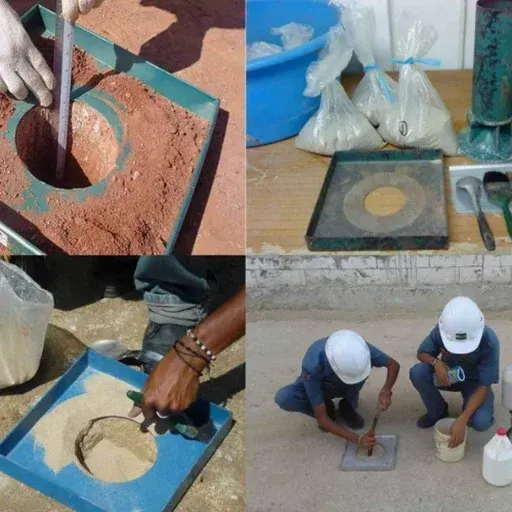
Site-specific factors
The field kit itself is refreshingly simple: a one-gallon plastic jar of calibrated sand, a metal base plate with a funnel, and a set of chisels and brushes for excavating the test hole. The real risk in Aberdeen isn't equipment failure but site conditions that corrupt the result. If the technician doesn't correctly seat the base plate on a rough granite-derived subbase, sand can leak under the rim and make the calculated volume meaningless. We also see problems when site teams try to test directly on top of a single large cobble embedded in till; the hole geometry becomes irregular and the sand does not fully conform to the cavity. Our protocol for Aberdeen jobs includes a visual inspection of the test location, rejection of any spot within 300 mm of a boulder edge, and immediate repetition of any test where the sand cone calibration factor is suspect. The method's repeatability—typically within 1.5% of the mean—means we catch faulty readings before they become a foundation problem.
Regulatory framework
BS 1377-9:1990 – Soils for civil engineering purposes, in-situ density tests, BS EN 1997-2:2007 (Eurocode 7) – Ground investigation and testing, HAUC Specification for the Reinstatement of Openings in Highways (Roads Authority, Aberdeen)
Complementary services
Compaction verification for roads and pavements
Testing on Type 1 subbase, capping layers, and bituminous pavement foundations in compliance with the Specification for Highway Works. Common on Aberdeen City Council and Aberdeenshire Council road projects, including roundabout reconstructions and industrial estate access roads.
Foundation pad and trench backfill QA
In-situ density checks beneath pad foundations, strip footings, and within utility trenches. We coordinate with the groundworks team to test each lift before the next is placed, ensuring compliance with project-specific compaction targets derived from laboratory Proctor references.
Combined compaction and CBR assessment
Where pavement design requires both compaction and strength data, we pair sand cone density tests with in-situ CBR measurements. This integrated approach gives the design engineer a complete picture of the subgrade and subbase performance in one site visit.
Typical parameters
Common questions
How much does a sand cone field density test cost in Aberdeen?
A single sand cone test on an Aberdeen site typically falls in the range of £70 to £130. The final figure depends on site access, the number of tests scheduled that day, and whether companion laboratory work like moisture content determination or Proctor density reference testing is required. We provide a firm quote after understanding the project location and the number of lifts to verify.
How quickly can you mobilise a technician to an Aberdeen site?
For sites within the city and the immediate suburbs—Bridge of Don, Kingswells, Altens, Portlethen—we can usually have a technician on site within 48 hours of instruction. Same-day or next-day response is possible for urgent reinstatement checks, though it is subject to existing scheduling. We always confirm timing during the booking call.
What is the smallest area you can test with the sand cone method?
The base plate requires a reasonably flat, undisturbed area about 200 mm in diameter. As long as the surface can accommodate the plate without rocking, we can test in tight spots such as narrow service trenches or around manhole frames. For extremely confined spaces, we discuss alternative approaches, but the standard sand cone kit is surprisingly adaptable.
The ground is very stony here—can the sand cone method still work?
Yes, but it requires extra care. In Aberdeen's bouldery glacial till, we reject test locations where a single large cobble dominates the excavation. We also increase the test hole volume to around 1600 cm³ so that the calibrated sand can average out the influence of smaller stones. The technician records a note on the test sheet whenever stone content is high, so the engineer interpreting the results has the full picture.
Do you handle the reinstatement of the test hole after the test?
We always backfill the test hole with the material removed, compact it in layers using a hand tamper, and leave the surface as close to its original condition as possible. On asphalt or rigid pavement areas where a small patch is needed, we coordinate with the main contractor's reinstatement crew so the repair matches the surrounding surface specification.