Geotechnical laboratory testing forms the bedrock of safe and successful construction across Aberdeen and the wider Grampian region. This category encompasses the full spectrum of physical and mechanical soil and rock analyses required to determine ground conditions, from basic classification to advanced strength and compressibility assessments. In a city where urban regeneration projects sit alongside coastal infrastructure and energy sector developments, precise laboratory data is not merely a regulatory checkbox; it is fundamental to mitigating ground-related risks and optimising foundation design.
Aberdeen's unique geological setting directly influences the laboratory testing regime required for any given site. Much of the city is underlain by complex glacial deposits, including the tills and glaciofluvial sands and gravels left behind by the retreat of the Devensian ice sheet. These materials can be highly variable, containing everything from soft, compressible clays to dense, bouldery strata. Furthermore, the presence of the Aberdeen granite pluton means weathered rockhead can be encountered at shallow depths, often overlain by a mantle of residual silty, sandy soils. This variability demands a rigorous approach to sample handling and testing to ensure that the behaviour of the ground is accurately characterised.
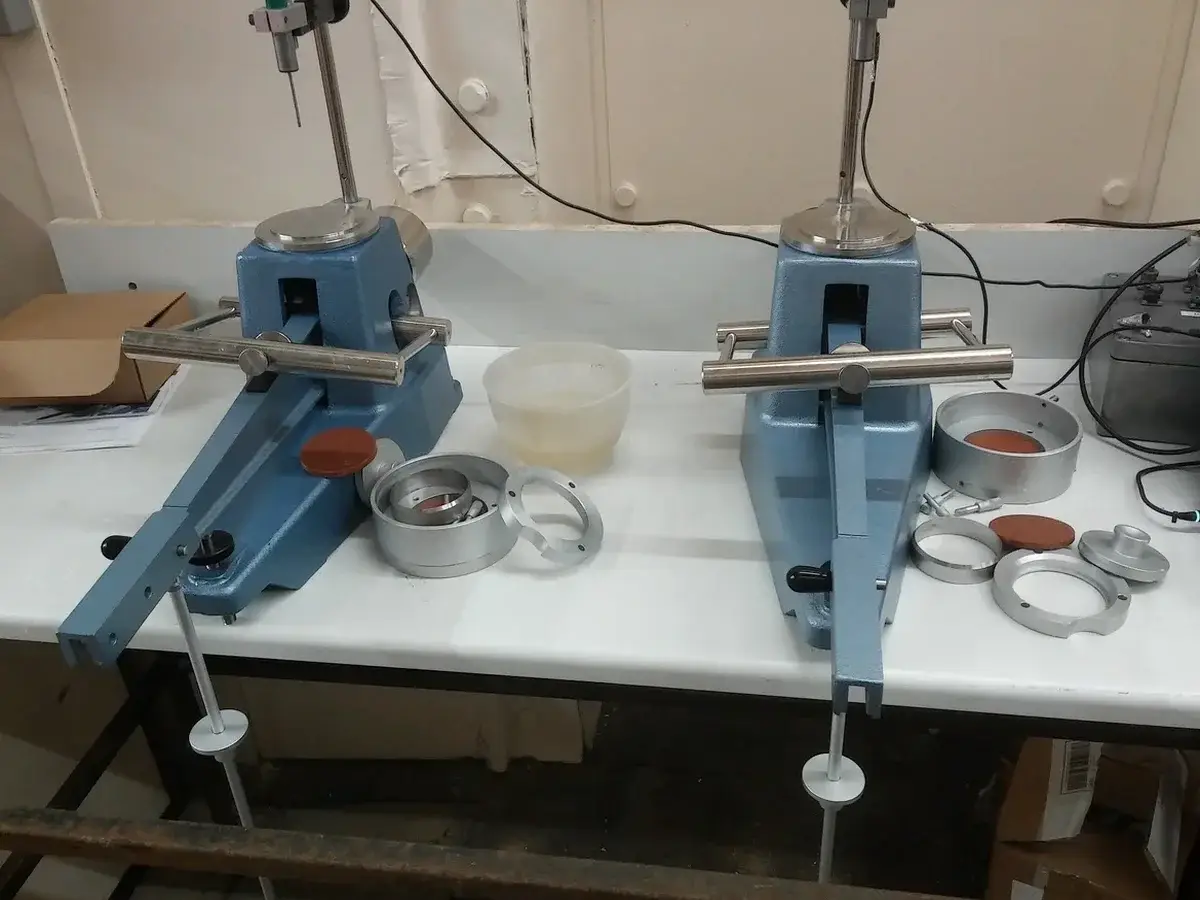
All testing within an Aberdeen laboratory is conducted in strict adherence to the relevant British Standards, primarily those within the BS 1377 series for soils, alongside BS EN ISO 17892 for geotechnical investigation and testing. For projects involving granular materials in pavement or earthworks, the Specification for Highway Works (SHW) Series 600 is often the governing document. These standards dictate everything from sample preparation and test methodology to equipment calibration and reporting formats, ensuring that results are defensible, repeatable, and acceptable to all stakeholders, including local authority engineers and regulatory bodies like SEPA. A proper laboratory will hold UKAS accreditation to ISO/IEC 17025 for its core tests, providing independent verification of its technical competence.
The types of projects in Aberdeen that depend on these laboratory services are diverse. For the energy sector, characterising the seabed and onshore soils for cable routes and substations requires a deep understanding of sediment behaviour. Urban commercial and residential developments rely heavily on Atterberg limits to assess the shrink-swell potential of clayey glacial tills, a critical factor for foundation design. Major infrastructure works, such as the Aberdeen Western Peripheral Route, demand extensive Proctor tests to ensure engineered fill meets compaction specifications, while triaxial test data is essential for analysing the stability of deep excavations and retaining walls in the city centre's mixed ground conditions.
Common questions
What suite of laboratory tests is typically required for a standard site investigation in Aberdeen?
A typical investigation in Aberdeen's glacial soils would begin with classification tests such as moisture content, bulk density, and Atterberg limits to define the soil's basic nature. This is followed by a particle size distribution analysis and, for cohesive materials, undrained shear strength tests like triaxial compression or quick undrained triaxial. Chemical testing for pH and sulphates is also standard to assess concrete design requirements in accordance with BRE Special Digest 1.
How do British Standards influence the laboratory testing process for an Aberdeen project?
British Standards, particularly BS 1377 and BS EN ISO 17892, prescribe the exact methodologies, equipment specifications, and reporting conventions for every test. This ensures data from an Aberdeen laboratory is consistent and comparable. Adherence to these standards, often verified through UKAS accreditation to ISO/IEC 17025, is typically a mandatory requirement in project specifications to guarantee the results are technically robust and legally defensible for design purposes.
What is the difference between a classification test and a strength test in a geotechnical context?
Classification tests, such as Atterberg limits and grain size analysis, identify and describe the soil's physical properties, like plasticity and particle grading, to place it into a recognised group. Strength tests, such as the triaxial test, measure the soil's mechanical behaviour under load, determining parameters like cohesion and friction angle. The former tells you what the material is; the latter tells you how it will perform under structural stress.
Why is UKAS accreditation important when choosing a geotechnical laboratory?
UKAS accreditation to ISO/IEC 17025 provides an independent, third-party audit of a laboratory's technical competence and quality management system. For an Aberdeen project, using a UKAS-accredited lab assures clients, designers, and regulators that the testing equipment is properly calibrated, staff are competent, and the procedures are strictly followed. This significantly reduces the risk of erroneous data being used in critical foundation and earthworks designs.