We see it repeatedly on Aberdeen sites: a contractor submits a CBR value from an assumed table, the pavement design gets approved, and six months later the granite fill turns to mush after the first North Sea storm. The laboratory CBR test isn't a tick-box exercise here. The weathered pink granite and quartz-mica-schist that underlie most of the city produce fines that behave nothing like the textbook curves in the Design Manual for Roads and Bridges. A proper soaked CBR, compacted to the specified dry density at optimum moisture content per BS 1377-4:1990, often reveals bearing values 40% lower than what the site agent assumed. We run the test under strict temperature control, with surcharge weights simulating the actual pavement structure, because the difference between 2% and 15% CBR on a subgrade in Aberdeen determines whether you need 150mm or 350mm of Type 1 sub-base. Before committing to the final capping layer thickness, a quick Proctor test establishes the compaction reference, and if the material is borderline granular, a grain size analysis confirms whether the fines content will affect drainage and frost susceptibility.
A soaked CBR value from a granite-derived subgrade in Aberdeen typically runs 40% lower than what textbook correlations predict.
Our approach and scope
Site-specific factors
BS 5930:2015+A1:2020 is explicit about the consequences of using natural moisture content CBR values for permanent works in the UK. In Aberdeen, the risk is amplified by the local geology. The city sits on the Dalradian Supergroup, with deeply weathered granite and micaceous schist that degrade rapidly when exposed to repeated wet-dry cycles. A pavement designed on an unsoaked CBR of 20% that drops to 5% after saturation will rut within the first two winters. We have seen this on industrial estate roads in Dyce and on access tracks in Kingswells. The soaked CBR test eliminates the optimism. If the result comes back below 2%, the subgrade requires stabilisation with lime or cement, which then triggers a different pavement design. For sites near the harbour where fill material includes dredged silts, the retaining walls and adjacent pavement layers need a consistent design CBR to avoid differential settlement at the interface.
Regulatory framework
BS 1377-4:1990 – Soaked CBR test method, BS EN 13286-47:2021 – Unbound and hydraulically bound mixtures, CBR, Specification for Highway Works (SHW) Clause 624 – Capping and sub-base, Design Manual for Roads and Bridges (DMRB) CD 225 – Pavement foundation design, BS 5930:2015+A1:2020 – Code of practice for ground investigations
Complementary services
Soaked CBR per BS 1377-4
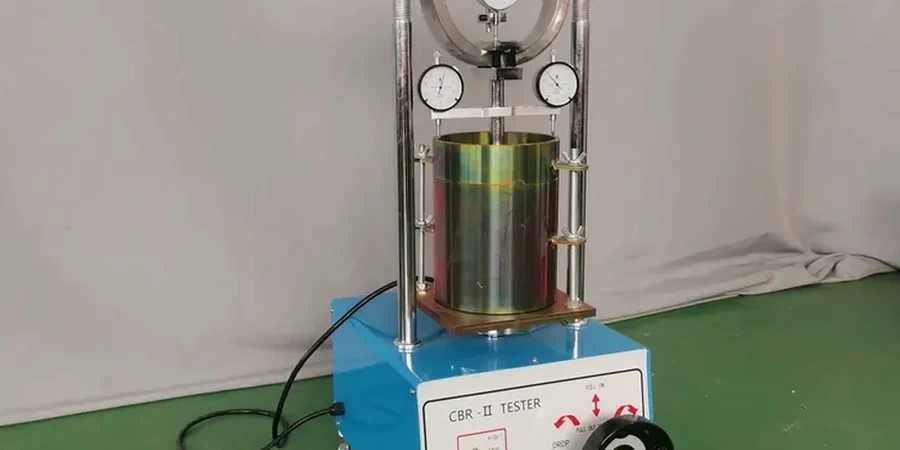
Full procedure with 96-hour soaking under surcharge, penetration testing at 1.27mm/min, and correction for concavity. We report CBR at 2.5mm and 5.0mm, the dry density, moisture content, and the percentage swelling during soak. Suitable for subgrade, capping, and Type 1 sub-base materials on road, car park, and industrial pavement projects across Aberdeen and Aberdeenshire.
CBR correlation package
For sites where multiple material types are encountered—granite fill, glacial till, and imported crushed rock—we run parallel Proctor, particle density, and grading tests to build a CBR-density-moisture envelope. This allows the pavement engineer to specify an achievable field density that guarantees the design CBR, rather than chasing a laboratory optimum that cannot be replicated under Aberdeen's weather conditions.
Typical parameters
Common questions
How much does a laboratory CBR test cost in Aberdeen?
A single soaked CBR test per BS 1377-4 typically ranges from £100 to £160, depending on the number of specimens and whether we need to determine the optimum moisture content first via a Proctor test. A three-point CBR (three specimens at different densities) costs more but gives the full CBR-density relationship, which is essential for pavement design optimisation on larger schemes.
How long does the CBR test take from sample delivery to report?
Standard turnaround is five working days, which includes the 96-hour soaking period, penetration testing, and reporting. We can deliver results in 48 hours on an express schedule if the sample arrives early Monday and the soaking phase is started immediately. The limiting factor is always the soak time, not the lab capacity.
Do you test in-situ samples or only remoulded specimens?
We test both. Remoulded specimens at the specified dry density and moisture content are standard per BS 1377-4. If you need to verify the CBR of an existing pavement layer, we can test undisturbed cores or blocks taken from site, though the SHW Clause 624 design method is based on remoulded soaked CBR values.
What CBR value is considered acceptable for a road subgrade in Aberdeen?
SHW Clause 624 requires a minimum CBR of 2% for the subgrade immediately beneath the capping layer. Below 2%, stabilisation or a thicker capping is mandatory. For a sub-base directly under the pavement, values of 15% to 30% are typical. On Aberdeen's granite-derived soils, we often see soaked CBR figures between 5% and 12% for the natural subgrade, which generally means a capping layer of 150mm to 350mm depending on the traffic loading.